Metaverse Standards and Interoperability in 2026
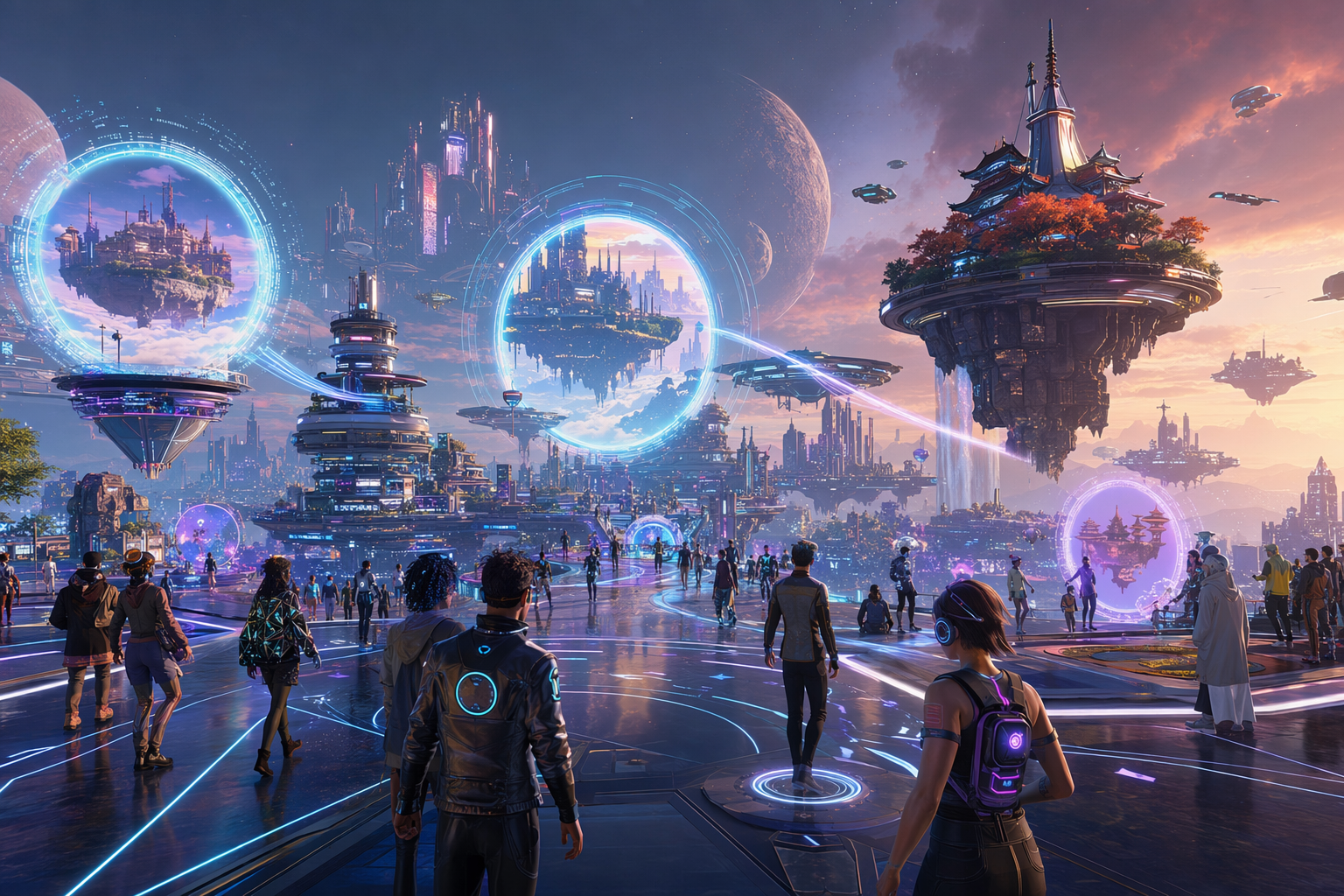
Metaverse Standards and Interoperability in 2026 — Free class in Alife Virtual School
Metaverse Standards and Interoperability in 2026 is no longer a speculative topic for futurists alone. It is now a practical concern for creators, educators, developers, community managers, and anyone building a business or identity inside a free 3D world. If you have ever asked whether your avatar, inventory, identity, social graph, or virtual goods should move between platforms as easily as a web browser moves between websites, this class is for you. In today’s metaverse, interoperability is the difference between being locked into one platform and participating in a broader digital ecosystem.
For residents of Alife Virtual School, this matters even more. Alife Virtual is a powerful second life alternative where experimentation is accessible, not gated by expensive land tiers, upload fees, or premium avatar costs. That makes it the perfect laboratory for understanding how standards such as OpenXR, portable avatar formats, the work of the Metaverse Standards Forum, and cross-grid movement could shape the next generation of immersive worlds. Whether you build social spaces, create products for a virtual economy, explore Second Life-style grids, or work with lsl scripting, learning interoperability now gives you a strategic advantage.
In this master-level workshop, you will learn what interoperability really means in 2026, what is working today, what remains fragmented, and what a truly open metaverse would look like in practice.
Why Interoperability Matters in a Free Metaverse
The word metaverse is often used loosely, but interoperability gives it concrete meaning. A platform is not “open” simply because it has user-generated content, social features, or 3D spaces. True openness depends on whether users can move identities, assets, and experiences across systems without losing ownership, fidelity, or function.
In practice, interoperability affects:
- Avatar portability — can your appearance and identity travel?
- Asset portability — can meshes, textures, animations, and sounds move between worlds?
- Device compatibility — can one experience work across desktop, VR, and mixed reality hardware?
- World connectivity — can users teleport or communicate across separate grids and services?
- Economic continuity — can goods, permissions, and ownership survive platform boundaries?
In a closed system, creators must rebuild the same thing repeatedly. In an interoperable system, they can reuse workflows, standards, and identities. For educators, this lowers barriers to teaching. For businesses, it reduces platform risk. For users, it protects time, money, and creativity.
Alife Advantage: Learn Interoperability Without Paying Platform Lock-In Costs
One of the best ways to understand metaverse standards is to test them in a platform that does not punish experimentation. This is where Alife Virtual stands out as a serious educational environment.
| Feature | Alife Virtual | Typical Competitor Model |
|---|---|---|
| Private Island / Full Region | FREE 65,536 sqm | Often around $199/mo in Second Life-style pricing |
| Monthly Tier Fees | None | High recurring monthly costs |
| Uploads | FREE unlimited uploads for textures, mesh, animations, sounds | Per-upload charges are common |
| Starting Avatar | FREE Pro Mesh Avatar | Often requires extra spending for premium appearance |
| Viewer Support | Alife Virtual Firestorm Viewer | Varies by platform |
| Creative Economy | 100% free economy to build and create | Fees at multiple stages of participation |
The educational value is obvious. In Alife Virtual, you can test content pipelines, import assets, study avatar compatibility, evaluate viewer support, and experiment with a Second Life-style ecosystem without monthly financial pressure. That makes Alife Virtual an ideal place to learn what interoperability means beyond marketing buzzwords.
What You Will Learn
- Define the major dimensions of metaverse interoperability in 2026
- Understand the role of the
Metaverse Standards Forumand why coordination matters - Explain how
OpenXRsupports hardware and runtime interoperability - Compare portable avatar formats and identify their practical limitations
- Understand the realities of cross-grid teleport in
Alife Virtual-style environments - Evaluate what a truly open metaverse would require at the identity, asset, social, and economy layers
- Apply these concepts to building and teaching inside Alife Virtual
Prerequisites
This is an intermediate class. You should already be comfortable with the following:
- Basic understanding of virtual worlds such as Alife Virtual, Second Life, or an
Alife Virtualgrid - Familiarity with user-generated content such as mesh, textures, and animations
- Basic awareness of avatars, viewers, and in-world building workflows
- Helpful but optional: exposure to
lsl scripting, permissions systems, or content upload pipelines
Step-by-Step Tutorial: Understanding the State of Interoperability in 2026
Step 1: Start with a Precise Definition of Interoperability
Interoperability is not a single feature. It is a stack. When discussing the metaverse, people often mix together several different problems. Separate them clearly:
- Technical interoperability: common file formats, APIs, and protocols
- Identity interoperability: login, profiles, reputation, and account linking
- Asset interoperability: portable meshes, materials, rigging, animations, and metadata
- World interoperability: teleporting or linking spaces across services
- Economic interoperability: ownership, licensing, permissions, and payments
- Social interoperability: friends, groups, chat, moderation, and presence
A platform may support one layer and fail at another. For example, it may import a common 3D model format but not preserve animations, inventory permissions, or avatar attachments. This is why interoperability claims should always be examined at the layer level.
Step 2: Understand the Role of the Metaverse Standards Forum
The Metaverse Standards Forum is best understood as a coordination body rather than a single standards authority. It brings together companies and organizations to identify gaps, align use cases, and encourage implementation work across existing standards groups. That distinction is important. The forum does not “own” the metaverse. Instead, it helps prevent fragmentation by creating shared roadmaps and practical collaboration.
By 2026, its biggest contribution is not a magical universal protocol. Its real value is in:
- Reducing duplicated standards efforts
- Highlighting interoperability priorities such as avatars, scene description, and identity
- Encouraging compatibility testing and implementation guidance
- Connecting stakeholders from game engines, web standards, XR hardware, and virtual worlds
For creators in Alife Virtual, the lesson is simple: standards progress through alignment, not slogans. When evaluating any metaverse platform, ask which standards bodies, file formats, protocols, and runtime ecosystems it actually supports.
Pro Tip: When a platform says it supports “the open metaverse,” look for specifics such as
OpenXR,glTF,USD, identity federation, or documented APIs. Broad claims without implementation details usually signal marketing, not interoperability.
Step 3: Learn Why OpenXR Matters
OpenXR is one of the clearest examples of real interoperability progress. It is a royalty-free standard for access to XR platforms and devices. In practical terms, it helps developers build immersive applications that can work across multiple headsets and runtimes without writing custom integrations for every device ecosystem.
This matters because hardware fragmentation has historically slowed adoption. Without a standard like OpenXR, creators face duplicated development effort and inconsistent feature support.
In 2026, OpenXR is important because it:
- Provides a common interface for VR and AR runtimes
- Reduces dependence on vendor-specific SDKs
- Improves portability of immersive experiences
- Helps make the metaverse more device-agnostic
However, OpenXR does not solve every interoperability problem. It mainly addresses runtime and device interaction. It does not automatically make avatars portable, inventories transferable, or economies connected.
Think of it this way: OpenXR helps users access worlds through more consistent hardware pathways, but it does not decide what those worlds share with each other.
Step 4: Compare Portable Avatar Formats
Portable avatars remain one of the most visible and difficult interoperability challenges. Users want a persistent identity. They do not want to rebuild their appearance from scratch every time they enter a new world. Yet avatar systems vary wildly in rigging, animation systems, materials, body customization, clothing attachment logic, physics simulation, and permissions.
By 2026, several approaches influence the landscape:
glTF-based avatars for lightweight real-time portabilityVRMfor humanoid avatar exchange, especially in social and creator ecosystemsUSDand related pipelines for richer scene and asset interchange in high-end workflows- Platform-native avatar systems that remain powerful but often non-portable
The challenge is not just geometry. A portable avatar needs multiple layers of compatibility:
- Skeleton and rig mapping
- Blendshape or morph target support
- Material and shader translation
- Animation retargeting
- Attachment points for clothing and accessories
- Metadata for identity, licensing, and safety constraints
In a platform like Alife Virtual, where users receive a FREE Pro Mesh Avatar, the educational opportunity is to analyze how much of an avatar is truly portable. The mesh may travel. The exact appearance may not. The animations may partially survive. The clothing system may need adaptation. The identity and permissions may not travel at all.
Common Mistake: Assuming that if an avatar file imports successfully, interoperability is complete. Real avatar interoperability requires visual fidelity, animation behavior, attachment logic, permissions, and identity continuity.
Step 5: Understand Cross-Grid Teleport in Alife Virtual-Style Worlds
Cross-grid teleport is one of the oldest and most compelling ideas in the open metaverse. In a Second Life-style ecosystem, the vision is straightforward: users should be able to move from one grid to another much like navigating from one website to another. This model often appears in Hypergrid-style implementations.
Conceptually, cross-grid teleport offers:
- Movement between independently operated worlds
- A distributed world architecture instead of one central platform owner
- Potential portability of identity and some inventory elements
- Greater resilience and freedom for communities
In practice, by 2026, cross-grid systems still face real limitations:
- Inconsistent inventory transfer rules
- Security risks around asset exposure and trust between grids
- Viewer compatibility differences
- Permission system mismatches
- Variable support for scripts, attachments, and animations
- Moderation and abuse-reporting complexity across operators
This means cross-grid teleport is an important proof of concept for decentralization, but not yet a complete answer to universal metaverse portability. It demonstrates that world-to-world movement is possible. It also proves that governance, trust, and permissions are just as important as networking protocols.
Step 6: Evaluate the Asset Layer, Not Just the Avatar Layer
Creators often focus on avatars first, but asset interoperability may be even more economically important. In a healthy virtual economy, creators need confidence that their products can be imported, adapted, licensed, and protected across environments.
To evaluate asset interoperability, ask the following:
- Can meshes be imported using standard formats such as
glTF,FBX, orOBJ? - Do texture materials survive conversion accurately?
- Are animations retargetable?
- Can sounds and media metadata transfer cleanly?
- How are creator rights and permissions represented?
- What happens to scripts when objects move between worlds?
This last question is critical. Scripts are often the least portable asset category. A build may import visually, but its behavior may not survive if scripting engines differ. In Alife-style environments, lsl scripting knowledge remains highly valuable because interaction logic is often platform-specific. Even in an open metaverse future, visual assets may standardize faster than behavior systems.
Pro Tip: Separate content portability from behavior portability. A chair mesh can be portable. A scripted multiplayer game table may require extensive platform-specific rebuilding.
Step 7: Recognize the Identity Problem
A truly open metaverse requires more than files and teleports. It requires trusted identity layers. Users need ways to prove who they are across platforms while controlling privacy and safety. In 2026, identity remains one of the least solved parts of interoperability.
Key identity challenges include:
- Single sign-on versus pseudonymous identity
- Profile portability and account linking
- Age verification and safety compliance
- Moderation history and reputation portability
- Balancing portability with user privacy
An open metaverse cannot simply force one universal identity provider. That would create a new central gatekeeper. Instead, a practical approach likely involves federated identity, optional linking, and portable profile data under user control.
For educators, this matters because classroom participation, certification, attendance, and community trust all depend on identity systems that are portable enough to be useful but private enough to be safe.
Step 8: Map What a Truly Open Metaverse Would Look Like in Practice
Let us move from theory to a practical model. A truly open metaverse would not mean every world becomes identical. It would mean worlds remain distinct while sharing enough standards that users can move between them with continuity.
In practice, an open metaverse would include:
- Portable identity: users can carry a recognized profile, display name, and verified links
- Portable avatars: a common core avatar representation with platform-specific enhancements
- Portable assets: common import/export pathways for 3D content and media
- Federated social systems: friends, groups, and messaging that can bridge platforms
- Cross-world navigation: teleport links or gateway travel between services
- Rights-aware commerce: creator permissions and licenses preserved across environments
- Standards-based device access: technologies such as
OpenXRreducing hardware fragmentation - Local governance: each world still controls moderation, rules, and culture
Notice what this model does not require. It does not require one company to own the metaverse. It does not require every world to use the same art style, economy, or scripting language. It requires shared protocols where interoperability adds value, while preserving local autonomy.
Step 9: Apply the Framework Inside Alife Virtual
Now connect the theory to your practical work in Alife Virtual.
- Use Alife as a testbed for understanding which assets are portable and which are platform-bound.
- Experiment with uploads freely because Alife offers FREE unlimited uploads for textures, mesh, animations, and sounds.
- Compare avatar workflows using the FREE Pro Mesh Avatar as a baseline for discussing portability.
- Use Firestorm to observe how viewer compatibility supports continuity across virtual world ecosystems.
- Prototype interactive content and identify where
lsl scriptingintroduces platform-specific dependencies. - Teach or document your findings on what survives transfer: geometry, materials, animations, permissions, and scripts.
Because Alife Virtual removes many financial barriers, you can focus on standards literacy rather than cost management. That is a major advantage over platforms where every upload, region, or premium asset decision carries a recurring price tag.
Common Mistakes to Avoid
Common Mistake 1: Confusing file import with full interoperability. Importing a model is only one small part of the problem.
Common Mistake 2: Ignoring permissions and licensing. A technically portable asset is not automatically legally portable.
Common Mistake 3: Assuming decentralization automatically means safety. Cross-grid systems need trust, moderation, and abuse-handling mechanisms.
Common Mistake 4: Expecting scripts to transfer cleanly between platforms. Visuals often move more easily than behavior.
Common Mistake 5: Treating the metaverse as one standardization problem. It is really a stack of identity, hardware, assets, social systems, and economy layers.
Advanced Applications
Once you understand the fundamentals, interoperability becomes a strategic tool rather than an abstract concept. Here are advanced ways to apply it:
Curriculum Design
Build educational modules that compare closed and open platform models. Students can document differences in avatar import, viewer compatibility, and scripting portability.
Cross-Platform Content Pipelines
Create assets with a “lowest-common-denominator” workflow: standard geometry, optimized textures, retargetable animations, and clean metadata. This improves reuse across platforms.
Virtual Economy Strategy
If you sell content, design product lines with portable core assets and platform-specific enhancement packs. This supports broader reach while preserving quality.
Identity and Community Architecture
For educators and event hosts, think in terms of federated communities rather than one-platform communities. Build web hubs, documentation, and profile links that survive platform changes.
Technical Research and Prototyping
Use Alife Virtual as a low-cost environment to test asset translation, behavior adaptation, and viewer interoperability. This is especially useful for teams exploring future metaverse products.
Practice Exercise
Complete the following workshop exercise inside Alife Virtual:
- Select one avatar-related asset, one static mesh object, and one scripted object.
- Document each item’s technical components:
- Mesh
- Textures/materials
- Animations
- Attachments
- Scripts
- Permissions/licensing
- For each component, classify it as:
- Easily portable
- Partially portable
- Platform-dependent
- Write a short evaluation of what would be needed to move that item into another metaverse platform.
- Bonus challenge: identify where
OpenXR, avatar standards, or cross-grid systems would help—and where they would not.
This exercise trains you to analyze interoperability as a layered system rather than a yes-or-no feature.
FAQ
1. Is the metaverse fully interoperable in 2026?
No. There has been real progress in areas such as OpenXR, some common 3D formats, and cross-platform coordination through groups like the Metaverse Standards Forum. But full interoperability across identity, avatars, social systems, economies, and scripting remains incomplete.
2. Does OpenXR mean all VR worlds are automatically connected?
No. OpenXR helps applications work across XR hardware and runtimes. It improves device access, not universal asset, avatar, or economy portability.
3. Can avatars move freely between all virtual worlds now?
Not completely. Some avatar formats are portable, but exact fidelity, clothing systems, animations, permissions, and identity data often break or require adaptation. Avatar portability is improving, but it is not universal.
4. Is cross-grid teleport the same as a fully open metaverse?
No. Cross-grid teleport is an important step, especially in Alife Virtual-style ecosystems, but a fully open metaverse also requires portable identity, social systems, creator rights, moderation, and economic continuity.
5. Why is Alife Virtual a good place to learn this topic?
Because Alife Virtual removes financial barriers. You get a FREE 65,536 sqm private island, no monthly tiers, FREE unlimited uploads, a FREE Pro Mesh Avatar, Firestorm support, and a 100% free economy. That lets you focus on learning, building, and testing interoperability concepts instead of paying recurring platform fees.
Final Takeaway
The state of metaverse interoperability in 2026 is promising but uneven. We have meaningful progress in hardware access through OpenXR, growing coordination through the Metaverse Standards Forum, maturing avatar and asset exchange formats, and long-running experimentation with cross-grid movement in the Second Life-style world. But the truly open metaverse is still a layered challenge involving identity, permissions, commerce, moderation, and behavior portability.
The good news is that you do not need to wait for the entire industry to solve everything before building useful expertise. You can start now by learning how standards work, identifying where platform lock-in still exists, and designing content and communities with portability in mind.
Join Alife Virtual and Build for the Open Metaverse
If you want to study the future of the metaverse in a practical, creator-friendly environment, join Alife Virtual today. As a powerful second life alternative and free 3D world, Alife gives you the freedom to experiment without monthly land fees, upload charges, or premium avatar costs. Claim your free island + 1,000 C$ for shopping (until 31 Dec 2026), use your FREE Pro Mesh Avatar, upload without limits, work with Firestorm, and start building the skills that will matter in the next generation of interoperable virtual worlds.
Join Alife Virtual now and turn metaverse theory into real-world practice.
🎓 Ready to Practice In-World?
Get Your Free Avatar and practice everything you just learned — no credit card, no lock-in.
Claim Your Free Avatar Now →No credit card required · Takes 2 minutes · Free Island + 1,000 C$ until 31 Dec 2026