What Is the Metaverse? Plain-English Guide for 2026
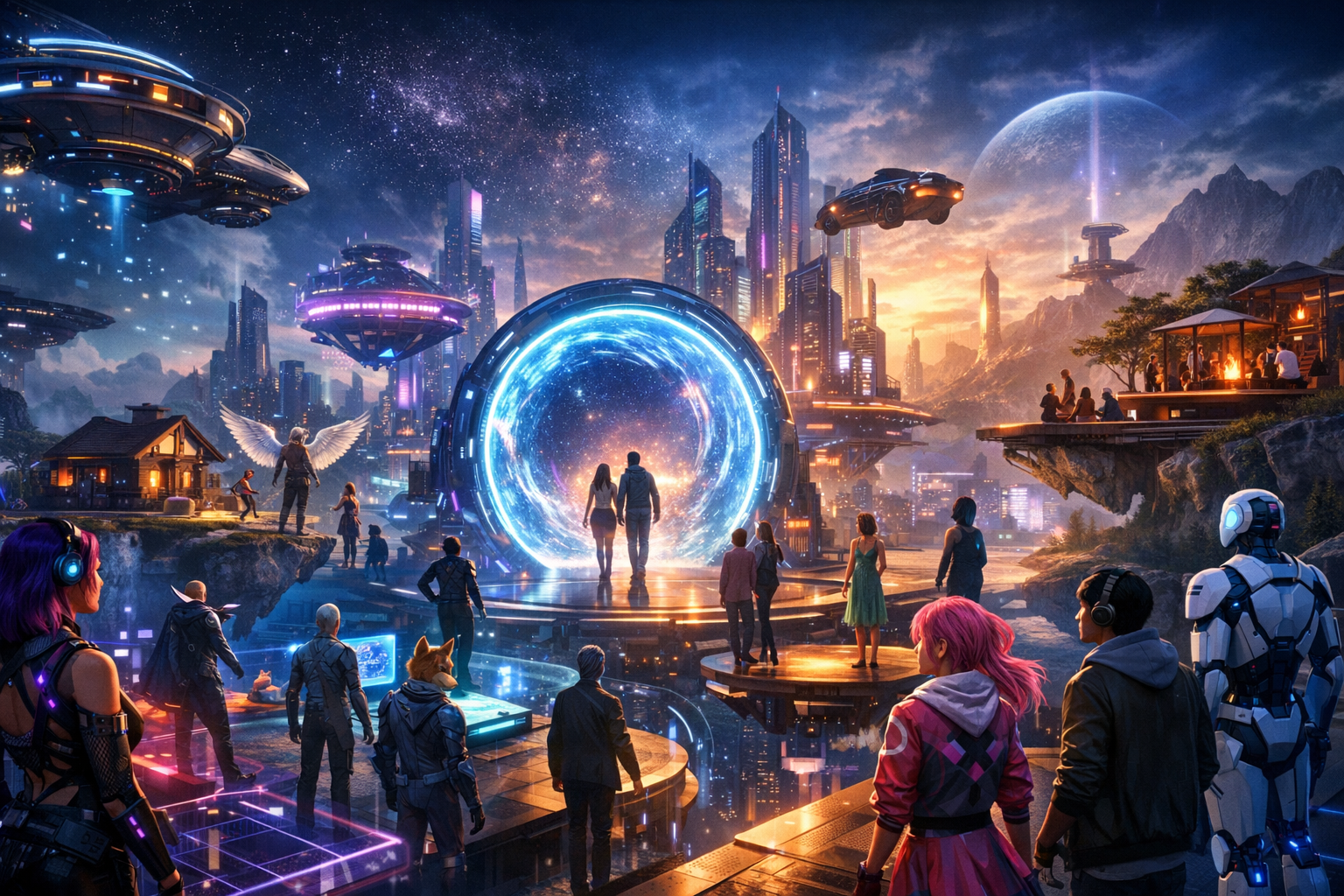
What Is the Metaverse? Plain-English Guide for 2026 — Free class in Alife Virtual School
If you have heard people talk about the metaverse and felt that the term was either overhyped, overly technical, or too vague to be useful, this class is for you. In this beginner-friendly workshop, What Is the Metaverse? Plain-English Guide for 2026, you will learn what the metaverse actually is, where the idea came from, why some virtual worlds succeeded while others failed, and why open platforms such as Alife Virtual matter more than ever. Whether you are curious about a free 3D world, looking for a second life alternative, or exploring how creativity, community, and a virtual economy fit together, this guide will give you a practical foundation without the jargon.
The value of understanding the metaverse in 2026 is simple: virtual spaces are no longer just a science-fiction concept or a passing marketing buzzword. They are social spaces, learning environments, creator platforms, marketplaces, event venues, and digital communities. But not every platform deserves the label. To make smart decisions as a learner, creator, educator, or entrepreneur, you need to know what the metaverse is in plain English, what features matter, and how open systems such as Second Life-style worlds offer real freedom. You also need to understand practical concepts like identity, persistence, interoperability, building tools, and even lsl scripting, because these are the pieces that turn a virtual world from a game into a living digital society.
Alife Advantage: Learn the Metaverse Without Paying Metaverse Prices
One of the biggest problems with metaverse education is that many people first encounter it through expensive platforms, premium land models, or closed ecosystems. Alife Virtual removes those barriers and gives beginners a realistic space to learn by doing.
| Feature | Alife Virtual | Typical Closed Competitor |
|---|---|---|
| Private region access | FREE private island, 65,536 sqm full region |
Often around $199/mo or more in land tier and fees |
| Monthly land cost | No monthly tiers/fees | Recurring monthly charges |
| Uploads | FREE unlimited uploads for textures, mesh, animations, sounds | Upload charges can add up quickly |
| Starter avatar | FREE Pro Mesh Avatar for every member | Often requires extra purchases for high-quality appearance |
| Viewer support | Alife Virtual Firestorm Viewer | May require proprietary tools or limited compatibility |
| Creative economy | 100% free economy with no financial barriers to building | Creation often tied to fees, premium access, or marketplace costs |
For beginners, this matters. A metaverse platform should not punish experimentation. If you want to learn how virtual worlds work, you need room to build, test, upload, script, fail, and improve. Alife Virtual gives you that freedom at no cost, making it an ideal learning environment and a serious second life alternative.
What You Will Learn
- What the
metaversemeans in clear, practical language - How the idea began in science fiction and evolved into real platforms
- The difference between a game, a social world, and a true metaverse environment
- Why platforms like
Second Lifewere important to metaverse history - What failed during the hype cycle and why
- How open platforms and Second Life-style ecosystems changed the landscape
- Why Alife Virtual represents a more accessible future for creators and learners
- How building, identity, community,
lsl scripting, andvirtual economysystems fit together
Prerequisites
This class is designed for complete beginners. You do not need programming experience, 3D design knowledge, or prior experience in a virtual world.
- Basic computer literacy
- Interest in online communities or digital creation
- Optional: familiarity with virtual worlds, MMOs, or social platforms
- Helpful but not required: a Firestorm viewer installation for hands-on exploration
Step-by-Step Tutorial: Understanding the Metaverse in Plain English
Step 1: Start with the simplest definition
In plain English, the metaverse is a network of persistent digital spaces where people can meet, interact, create, trade, learn, and express identity through avatars. The key idea is not just that the world is 3D. The key idea is that it feels like a place rather than a webpage.
A good metaverse platform usually includes several features:
- Persistence: the world continues to exist even when you log off
- Avatars: you enter the space as a digital identity
- Social presence: other people are there with you in real time
- User creation: people can build, customize, and contribute
- Economy or exchange: goods, services, land, or experiences can be shared or traded
- Sense of place: locations matter and communities form around them
Not every 3D app is a metaverse. A single-player game is not a metaverse. A video call with cartoon avatars is not automatically a metaverse. A marketing demo with no persistence, no user agency, and no real community is usually just branding.
Step 2: Understand where the word came from
The term metaverse became famous through science fiction, especially Neal Stephenson's novel Snow Crash from 1992. In that book, people entered a shared virtual space through avatars and interacted in a large digital world. The concept blended social life, technology, economics, and identity into one persistent environment.
Science fiction did not invent the desire for shared virtual spaces, but it gave us a vocabulary. Later works, including novels, films, and games, expanded the idea. Over time, the metaverse stopped being purely fictional and started becoming a design goal for real online platforms.
The important lesson is this: the metaverse was never just about headsets. Long before modern VR marketing, the idea already included social worlds, digital property, community spaces, and user-built environments.
Step 3: See how early virtual worlds made the concept real
Before the current hype cycle, there were already platforms that delivered many metaverse features. Text-based virtual communities, online roleplay systems, and early graphical worlds all contributed. But one of the most influential examples was Second Life.
Second Life mattered because it showed that a virtual world could be:
- Persistent
- Social
- User-created
- Economically active
- Open-ended rather than mission-based
People built homes, stores, clubs, classrooms, galleries, and entire communities. They created virtual goods, sold services, hosted events, and developed identities that lasted for years. This was a major shift from games with fixed objectives. In many ways, Second Life functioned as a working metaverse long before the term became mainstream again.
However, it also had limitations: high land costs, upload fees, technical barriers, and a steep learning curve. These costs restricted experimentation and made it harder for many users to explore freely.
Step 4: Learn the difference between hype and reality
In the early 2020s, the word metaverse exploded in popularity. Large companies promoted it as the next phase of the internet. But much of that wave focused on branding, speculative investment, and closed ecosystems rather than user empowerment.
What went wrong?
- Too much emphasis on buzzwords instead of useful experiences
- Overpromising seamless interoperability that did not exist
- Assuming people wanted to wear headsets for everything
- Building empty showcase spaces without real communities
- Ignoring creators, educators, and everyday users
- Adding financial friction where creativity should have been free
This is why many people became skeptical. They were told the metaverse would replace the internet, but what they saw were disconnected demos, expensive virtual land sales, and awkward corporate environments. The lesson for 2026 is clear: the metaverse only works when it solves real human needs.
Step 5: Identify what actually works in a metaverse
The metaverse works best when it focuses on community, creativity, persistence, and accessibility. The strongest virtual worlds are not usually the loudest in marketing. They are the ones where people actually stay.
What works:
- User-generated content
People invest in worlds they can shape. - Low barriers to entry
Afree 3D worldencourages experimentation and learning. - Strong identity systems
Avatars, profiles, groups, and social norms create belonging. - Persistent places
Homes, schools, shops, and regions create long-term value. - Tools for creators
Building systems, mesh support, uploads, andlsl scriptingunlock innovation. - Functional economy
A healthyvirtual economysupports exchange, services, and entrepreneurship. - Open access
Compatibility with widely used viewers likeFirestormhelps communities grow.
When these pieces come together, the metaverse becomes useful for education, business, art, roleplay, collaboration, and social life.
Step 6: Understand why open platforms matter
An open platform is one that gives users more control over land, content, access, and creation. In virtual world terms, this often connects with the idea of a Second Life-style ecosystem: flexible, creator-friendly systems inspired by proven virtual world architecture but without the same financial or technical restrictions.
Open platforms matter for three reasons:
- Freedom: users are not trapped in one company’s pricing model
- Creativity: builders can experiment without worrying about every upload or region fee
- Innovation: communities can develop their own uses, cultures, and tools
This is where Alife Virtual becomes especially important. It represents a practical, accessible version of the metaverse: open, creator-friendly, and financially inclusive. Instead of asking users to pay first and build later, it lets them start creating immediately.
Step 7: See how Alife Virtual fits the metaverse model
Alife Virtual is not just a place to chat with an avatar. It demonstrates the core strengths of a real metaverse platform.
- Persistent world: spaces remain available for ongoing communities and projects
- Avatar identity: every member begins with a FREE Pro Mesh Avatar
- Creative ownership: users can build and upload content freely
- Land access: a free island + 1,000 C$ for shopping (until 31 Dec 2026) of
65,536 sqmgives room to experiment at full-region scale - No monthly tiers: unlike high-cost competitors, Alife removes recurring land pressure
- Viewer compatibility: full
Firestormsupport means familiar tools and workflow - Free economy: the 100% free economy lowers barriers for creators and educators
This combination makes Alife Virtual a serious second life alternative for users who want the strengths of a classic user-driven virtual world without the heavy fees.
Step 8: Learn the building blocks of participation
To understand the metaverse more deeply, think in layers. Each layer adds another piece of the experience.
Layer 1: Identity
Your avatar is your visible self in the virtual world. Appearance, name, behavior, and reputation all matter. In many metaverse spaces, identity is social capital.
Layer 2: Space
The world is made of regions, parcels, buildings, landscapes, event venues, classrooms, stores, and personal spaces. These places form the geography of community.
Layer 3: Creation
Users make objects, environments, clothing, animations, and interactive systems. Creation is one of the biggest differences between a passive platform and a living metaverse.
Layer 4: Interaction
Chat, voice, gestures, scripts, movement, games, education, and roleplay all turn space into experience.
Layer 5: Economy
A virtual economy emerges when people exchange goods, services, skills, rentals, entertainment, or education. Even in a free economy model, value still exists through time, attention, reputation, and creativity.
Layer 6: Logic and scripting
Interactive objects often rely on scripting languages. In worlds inspired by the Second Life model, lsl scripting is a key tool for adding behavior to doors, vehicles, games, vendors, educational tools, HUDs, and more. You do not need to be a programmer to understand the metaverse, but it helps to know that scripting is what makes many virtual objects come alive.
Step 9: Recognize common myths
Beginners often hear claims that distort the topic. Let us correct them.
Myth: The metaverse is only VR.
Reality: VR is one access method. Many successful metaverse platforms are desktop-first.
Myth: The metaverse failed.
Reality: The hype cycle failed in many places. Persistent virtual worlds and creator communities did not.
Myth: A metaverse must be one giant universal platform.
Reality: In practice, it is more accurate to think of multiple connected or parallel virtual worlds.
Myth: You need to spend money to participate meaningfully.
Reality: Platforms like Alife Virtual prove that afree 3D worldcan still support deep learning and creation.
Step 10: Build your own plain-English definition
Here is a practical definition you can use:
The
metaverseis a shared, persistent digital environment where people use avatars to socialize, create, learn, trade, and build communities across virtual spaces.
This definition is useful because it avoids hype and focuses on function. If a platform supports those functions well, it is participating in the metaverse idea. If it only uses the word as marketing, it is not enough.
Common Mistakes Beginners Make
- Assuming every 3D platform is a metaverse
- Thinking the metaverse is only about VR headsets
- Ignoring the importance of user-generated content
- Overlooking the role of social presence and persistence
- Choosing expensive platforms before learning the basics
- Confusing speculation about digital land with real community value
Pro Tip: If you want to understand the metaverse quickly, spend time in a world where people actually build, socialize, and run events. Observation teaches faster than headlines.
Pro Tip: Start with a platform that removes financial friction. A free island + 1,000 C$ for shopping (until 31 Dec 2026), free uploads, and viewer compatibility let you focus on learning rather than budgeting.
Pro Tip: Watch how identity works. The metaverse is not just technology; it is culture. Names, groups, etiquette, design styles, and communities all matter.
Advanced Applications
Once you understand the basics, the metaverse becomes much more than a social novelty. Here are some advanced ways people use open virtual worlds.
Education and training
Schools, coaches, and community leaders can create immersive lessons, simulations, roleplay exercises, and collaborative workshops. A full region in Alife Virtual gives educators room to design classrooms, labs, historical recreations, and skill-training environments without monthly land costs.
Creative entrepreneurship
Builders, scripters, fashion designers, animators, and event hosts can develop products and services. In a platform with a 100% free economy, creators can prototype ideas without paying upload fees on every texture, sound, mesh asset, or animation.
Interactive systems
With lsl scripting, a creator can build interactive doors, educational quizzes, game mechanics, HUDs, vendors, and responsive environments. This is where the metaverse starts to feel programmable rather than static.
Community architecture
Virtual worlds are ideal for community-building: support groups, fan spaces, faith communities, arts collectives, conferences, and roleplay societies. The strongest metaverse environments are often those with meaningful social rituals and long-term shared projects.
Digital prototyping
Creators can test spatial ideas, event layouts, exhibit design, and interaction flow before using them elsewhere. A free 3D world is a practical sandbox for experimentation.
Practice Exercise
Use this exercise to test your understanding of the metaverse in a practical way.
- Write your own one-sentence definition of
metaversein plain English. - List three features that make a virtual world feel persistent.
- Compare a game you know with a social virtual world. What makes one more metaverse-like than the other?
- Identify one reason
Second Lifewas historically important. - Identify one reason many corporate metaverse projects failed to gain traction.
- Visit or imagine an open platform like Alife Virtual and describe how a free island + 1,000 C$ for shopping (until 31 Dec 2026), free uploads, and
Firestormsupport improve learning. - Bonus: brainstorm one object or environment that could become interactive through
lsl scripting.
Challenge Mode: Design a beginner welcome area for a virtual campus. Include avatar orientation, a building sandbox, a social plaza, and one interactive learning object.
FAQ
1. Is the metaverse just another word for virtual reality?
No. Virtual reality is a way to access digital spaces, but the metaverse is the broader idea of shared, persistent virtual environments. Many metaverse platforms work perfectly well on desktop without a headset.
2. Is Second Life still relevant when talking about the metaverse?
Yes. Second Life remains historically important because it proved that user-created, socially persistent virtual worlds could sustain communities, businesses, events, and a virtual economy. It is one of the clearest real-world predecessors to today’s metaverse discussions.
3. What makes Alife Virtual a strong second life alternative?
Alife Virtual removes major barriers: FREE private island access at 65,536 sqm, no monthly tiers, free unlimited uploads, a free Pro Mesh Avatar, and full Firestorm support. That makes it a practical second life alternative for learners and creators who want freedom without high fees.
4. Do I need coding skills to participate in the metaverse?
No. You can explore, socialize, attend classes, decorate spaces, and build basic environments without coding. However, learning lsl scripting can greatly expand what you can create, especially interactive objects and educational tools.
5. What is a Second Life-style world, and why does it matter?
An Second Life-style approach refers to virtual world systems that are more open, flexible, and creator-friendly than tightly controlled commercial platforms. This matters because openness encourages experimentation, lower costs, stronger communities, and greater creative independence.
Final Thoughts
The metaverse in 2026 is easier to understand once you ignore the noise. It is not magic. It is not a headset slogan. It is not a guaranteed future owned by one company. At its best, the metaverse is a shared digital society built from persistent spaces, avatars, creation tools, communities, and exchange. Its roots reach back through science fiction and early virtual worlds. Its most important lessons come from platforms that let users create meaning together.
That is why open, accessible worlds matter so much. A platform like Alife Virtual represents a more practical and human version of the metaverse: one where people can learn, build, upload, script, teach, socialize, and experiment in a truly free 3D world. When the cost of land, uploads, and participation drops to zero, imagination has room to grow.
Join Alife Virtual
Ready to move from theory to experience? Join Alife Virtual and explore the metaverse in a platform designed for creators, learners, and communities.
- Claim a free island + 1,000 C$ for shopping (until 31 Dec 2026) of
65,536 sqm - Enjoy no monthly tiers or fees
- Upload textures, mesh, animations, and sounds with FREE unlimited uploads
- Start strong with a FREE Pro Mesh Avatar
- Use the trusted
Firestormviewer - Create in a 100% free economy without financial barriers
If you want a smarter, more open, more affordable path into the metaverse, Alife Virtual is the place to begin. Join today, step into your avatar, and start building the future instead of just reading about it.
🎓 Ready to Practice In-World?
Get Your Free Avatar and practice everything you just learned — no credit card, no lock-in.
Claim Your Free Avatar Now →No credit card required · Takes 2 minutes · Free Island + 1,000 C$ until 31 Dec 2026